


Page 16 - Demo
P. 16
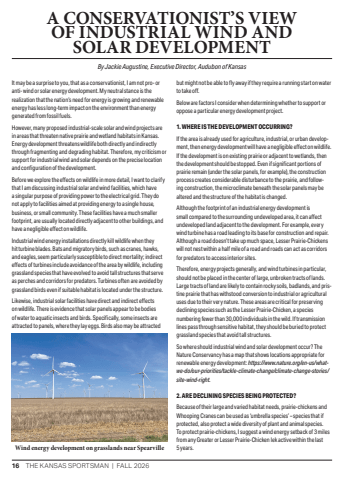
16 THE KANSAS SPORTSMAN | FALL 2026A CONSERVATIONIST%u2019S VIEW OF INDUSTRIAL WIND AND SOLAR DEVELOPMENTBy Jackie Augustine, Executive Director, Audubon of KansasIt may be a surprise to you, that as a conservationist, I am not pro- or anti- wind or solar energy development. My neutral stance is the realization that the nation%u2019s need for energy is growing and renewable energy has less long-term impact on the environment than energy generated from fossil fuels. However, many proposed industrial-scale solar and wind projects are in areas that threaten native prairie and wetland habitats in Kansas. Energy development threatens wildlife both directly and indirectly through fragmenting and degrading habitat. Therefore, my criticism or support for industrial wind and solar depends on the precise location and configuration of the development. Before we explore the effects on wildlife in more detail, I want to clarify that I am discussing industrial solar and wind facilities, which have a singular purpose of providing power to the electrical grid. They do not apply to facilities aimed at providing energy to a single house, business, or small community. These facilities have a much smaller footprint, are usually located directly adjacent to other buildings, and have a negligible effect on wildlife.Industrial wind energy installations directly kill wildlife when they hit turbine blades. Bats and migratory birds, such as cranes, hawks, and eagles, seem particularly susceptible to direct mortality; indirect effects of turbines include avoidance of the area by wildlife, including grassland species that have evolved to avoid tall structures that serve as perches and corridors for predators. Turbines often are avoided by grassland birds even if suitable habitat is located under the structure.Likewise, industrial solar facilities have direct and indirect effects on wildlife. There is evidence that solar panels appear to be bodies of water to aquatic insects and birds. Specifically, some insects are attracted to panels, where they lay eggs. Birds also may be attracted but might not be able to fly away if they require a running start on water to take off.Below are factors I consider when determining whether to support or oppose a particular energy development project. 1. WHERE IS THE DEVELOPMENT OCCURRING? If the area is already used for agriculture, industrial, or urban development, then energy development will have a negligible effect on wildlife. If the development is on existing prairie or adjacent to wetlands, then the development should be stopped. Even if significant portions of prairie remain (under the solar panels, for example), the construction process creates considerable disturbance to the prairie, and following construction, the microclimate beneath the solar panels may be altered and the structure of the habitat is changed. Although the footprint of an industrial energy development is small compared to the surrounding undeveloped area, it can affect undeveloped land adjacent to the development. For example, every wind turbine has a road leading to its base for construction and repair. Although a road doesn%u2019t take up much space, Lesser Prairie-Chickens will not nest within a half mile of a road and roads can act as corridors for predators to access interior sites. Therefore, energy projects generally, and wind turbines in particular, should not be placed in the center of large, unbroken tracts of lands. Large tracts of land are likely to contain rocky soils, badlands, and pristine prairie that has withstood conversion to industrial or agricultural uses due to their very nature. These areas are critical for preserving declining species such as the Lesser Prairie-Chicken, a species numbering fewer than 30,000 individuals in the wild. If transmission lines pass through sensitive habitat, they should be buried to protect grassland species that avoid tall structures.So where should industrial wind and solar development occur? The Nature Conservancy has a map that shows locations appropriate for renewable energy development: https://www.nature.org/en-us/whatwe-do/our-priorities/tackle-climate-change/climate-change-stories/site-wind-right. 2. ARE DECLINING SPECIES BEING PROTECTED? Because of their large and varied habitat needs, prairie-chickens and Whooping Cranes can be used as %u2018umbrella species%u2019 %u2013 species that if protected, also protect a wide diversity of plant and animal species. To protect prairie-chickens, I suggest a wind energy setback of 3 miles from any Greater or Lesser Prairie-Chicken lek active within the last Wind energy development on grasslands near Spearville 5 years.


