


Page 15 - Demo
P. 15
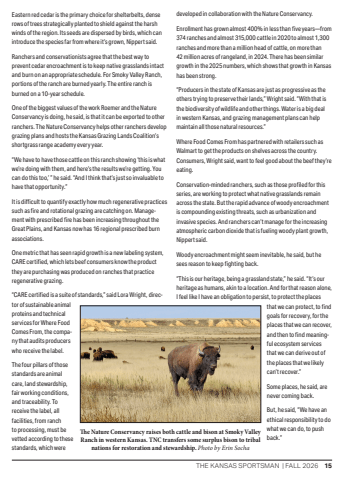
THE KANSAS SPORTSMAN | FALL 2026 15Eastern red cedar is the primary choice for shelterbelts, dense rows of trees strategically planted to shield against the harsh winds of the region. Its seeds are dispersed by birds, which can introduce the species far from where it%u2019s grown, Nippert said.Ranchers and conservationists agree that the best way to prevent cedar encroachment is to keep native grasslands intact and burn on an appropriate schedule. For Smoky Valley Ranch, portions of the ranch are burned yearly. The entire ranch is burned on a 10-year schedule.One of the biggest values of the work Roemer and the Nature Conservancy is doing, he said, is that it can be exported to other ranchers. The Nature Conservancy helps other ranchers develop grazing plans and hosts the Kansas Grazing Lands Coalition%u2019s shortgrass range academy every year.%u201cWe have to have those cattle on this ranch showing %u2018this is what we%u2019re doing with them, and here%u2019s the results we%u2019re getting. You can do this too,%u2019 %u201d he said. %u201cAnd I think that%u2019s just so invaluable to have that opportunity.%u201dIt is difficult to quantify exactly how much regenerative practices such as fire and rotational grazing are catching on. Management with prescribed fire has been increasing throughout the Great Plains, and Kansas now has 16 regional prescribed burn associations.One metric that has seen rapid growth is a new labeling system, CARE certified, which lets beef consumers know the product they are purchasing was produced on ranches that practice regenerative grazing.%u201cCARE certified is a suite of standards,%u201d said Lora Wright, director of sustainable animal proteins and technical services for Where Food Comes From, the company that audits producers who receive the label.The four pillars of those standards are animal care, land stewardship, fair working conditions, and traceability. To receive the label, all facilities, from ranch to processing, must be vetted according to these standards, which were developed in collaboration with the Nature Conservancy.Enrollment has grown almost 400% in less than five years%u2014from 374 ranches and almost 315,000 cattle in 2020 to almost 1,300 ranches and more than a million head of cattle, on more than 42 million acres of rangeland, in 2024. There has been similar growth in the 2025 numbers, which shows that growth in Kansas has been strong.%u201cProducers in the state of Kansas are just as progressive as the others trying to preserve their lands,%u201d Wright said. %u201cWith that is the biodiversity of wildlife and other things. Water is a big deal in western Kansas, and grazing management plans can help maintain all those natural resources.%u201dWhere Food Comes From has partnered with retailers such as Walmart to get the products on shelves across the country. Consumers, Wright said, want to feel good about the beef they%u2019re eating.Conservation-minded ranchers, such as those profiled for this series, are working to protect what native grasslands remain across the state. But the rapid advance of woody encroachment is compounding existing threats, such as urbanization and invasive species. And ranchers can%u2019t manage for the increasing atmospheric carbon dioxide that is fueling woody plant growth, Nippert said.Woody encroachment might seem inevitable, he said, but he sees reason to keep fighting back.%u201cThis is our heritage, being a grassland state,%u201d he said. %u201cIt%u2019s our heritage as humans, akin to a location. And for that reason alone, I feel like I have an obligation to persist, to protect the places that we can protect, to find goals for recovery, for the places that we can recover, and then to find meaningful ecosystem services that we can derive out of the places that we likely can%u2019t recover.%u201dSome places, he said, are never coming back.But, he said, %u201cWe have an ethical responsibility to do what we can do, to push back.%u201dThe Nature Conservancy raises both cattle and bison at Smoky Valley Ranch in western Kansas. TNC transfers some surplus bison to tribal nations for restoration and stewardship. Photo by Erin Socha


