


Page 14 - Demo
P. 14
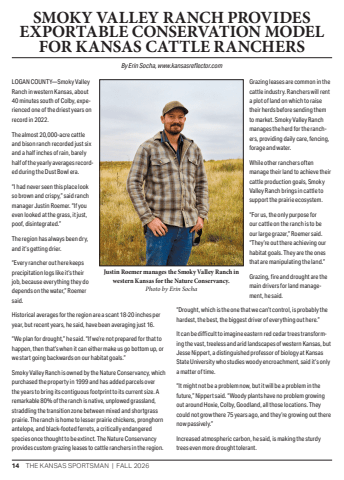
14 THE KANSAS SPORTSMAN | FALL 2026SMOKY VALLEY RANCH PROVIDES EXPORTABLE CONSERVATION MODEL FOR KANSAS CATTLE RANCHERSBy Erin Socha, www.kansasreflector.comLOGAN COUNTY%u2014Smoky Valley Ranch in western Kansas, about 40 minutes south of Colby, experienced one of the driest years on record in 2022.The almost 20,000-acre cattle and bison ranch recorded just six and a half inches of rain, barely half of the yearly averages recorded during the Dust Bowl era.%u201cI had never seen this place look so brown and crispy,%u201d said ranch manager Justin Roemer. %u201cIf you even looked at the grass, it just, poof, disintegrated.%u201dThe region has always been dry, and it%u2019s getting drier.%u201cEvery rancher out here keeps precipitation logs like it%u2019s their job, because everything they do depends on the water,%u201d Roemer said.Historical averages for the region are a scant 18-20 inches per year, but recent years, he said, have been averaging just 16.%u201cWe plan for drought,%u201d he said. %u201cIf we%u2019re not prepared for that to happen, then that%u2019s when it can either make us go bottom up, or we start going backwards on our habitat goals.%u201dSmoky Valley Ranch is owned by the Nature Conservancy, which purchased the property in 1999 and has added parcels over the years to bring its contiguous footprint to its current size. A remarkable 80% of the ranch is native, unplowed grassland, straddling the transition zone between mixed and shortgrass prairie. The ranch is home to lesser prairie chickens, pronghorn antelope, and black-footed ferrets, a critically endangered species once thought to be extinct. The Nature Conservancy provides custom grazing leases to cattle ranchers in the region.Grazing leases are common in the cattle industry. Ranchers will rent a plot of land on which to raise their herds before sending them to market. Smoky Valley Ranch manages the herd for the ranchers, providing daily care, fencing, forage and water.While other ranchers often manage their land to achieve their cattle production goals, Smoky Valley Ranch brings in cattle to support the prairie ecosystem.%u201cFor us, the only purpose for our cattle on the ranch is to be our large grazer,%u201d Roemer said. %u201cThey%u2019re out there achieving our habitat goals. They are the ones that are manipulating the land.%u201dGrazing, fire and drought are the main drivers for land management, he said.%u201cDrought, which is the one that we can%u2019t control, is probably the hardest, the best, the biggest driver of everything out here.%u201dIt can be difficult to imagine eastern red cedar trees transforming the vast, treeless and arid landscapes of western Kansas, but Jesse Nippert, a distinguished professor of biology at Kansas State University who studies woody encroachment, said it%u2019s only a matter of time.%u201cIt might not be a problem now, but it will be a problem in the future,%u201d Nippert said. %u201cWoody plants have no problem growing out around Hoxie, Colby, Goodland, all those locations. They could not grow there 75 years ago, and they%u2019re growing out there now passively.%u201dIncreased atmospheric carbon, he said, is making the sturdy trees even more drought tolerant.Justin Roemer manages the Smoky Valley Ranch in western Kansas for the Nature Conservancy. Photo by Erin Socha


