


Page 7 - Demo
P. 7
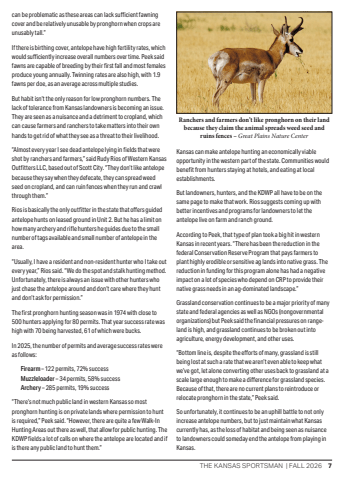
THE KANSAS SPORTSMAN | FALL 2026 7can be problematic as these areas can lack sufficient fawning cover and be relatively unusable by pronghorn when crops are unusably tall.%u201dIf there is birthing cover, antelope have high fertility rates, which would sufficiently increase overall numbers over time. Peek said fawns are capable of breeding by their first fall and most females produce young annually. Twinning rates are also high, with 1.9 fawns per doe, as an average across multiple studies.But habit isn%u2019t the only reason for low pronghorn numbers. The lack of tolerance from Kansas landowners is becoming an issue. They are seen as a nuisance and a detriment to cropland, which can cause farmers and ranchers to take matters into their own hands to get rid of what they see as a threat to their livelihood. %u201cAlmost every year I see dead antelope lying in fields that were shot by ranchers and farmers,%u201d said Rudy Rios of Western Kansas Outfitters LLC, based out of Scott City. %u201cThey don%u2019t like antelope because they say when they defecate, they can spread weed seed on cropland, and can ruin fences when they run and crawl through them.%u201dRios is basically the only outfitter in the state that offers guided antelope hunts on leased ground in Unit 2. But he has a limit on how many archery and rifle hunters he guides due to the small number of tags available and small number of antelope in the area.%u201cUsually, I have a resident and non-resident hunter who I take out every year,%u201d Rios said. %u201cWe do the spot and stalk hunting method. Unfortunately, there is always an issue with other hunters who just chase the antelope around and don%u2019t care where they hunt and don%u2019t ask for permission.%u201dThe first pronghorn hunting season was in 1974 with close to 500 hunters applying for 80 permits. That year success rate was high with 70 being harvested, 61 of which were bucks.In 2025, the number of permits and average success rates were as follows: Firearm %u2013 122 permits, 72% successMuzzleloader %u2013 34 permits, 58% successArchery %u2013 285 permits, 19% success%u201cThere%u2019s not much public land in western Kansas so most pronghorn hunting is on private lands where permission to hunt is required,%u201d Peek said. %u201cHowever, there are quite a few Walk-In Hunting Areas out there as well, that allow for public hunting. The KDWP fields a lot of calls on where the antelope are located and if is there any public land to hunt them.%u201dKansas can make antelope hunting an economically viable opportunity in the western part of the state. Communities would benefit from hunters staying at hotels, and eating at local establishments.But landowners, hunters, and the KDWP all have to be on the same page to make that work. Rios suggests coming up with better incentives and programs for landowners to let the antelope live on farm and ranch ground.According to Peek, that type of plan took a big hit in western Kansas in recent years. %u201cThere has been the reduction in the federal Conservation Reserve Program that pays farmers to plant highly erodible or sensitive ag lands into native grass. The reduction in funding for this program alone has had a negative impact on a lot of species who depend on CRP to provide their native grass needs in an ag-dominated landscape.%u201dGrassland conservation continues to be a major priority of many state and federal agencies as well as NGOs (nongovernmental organizations) but Peek said the financial pressures on rangeland is high, and grassland continues to be broken out into agriculture, energy development, and other uses.%u201cBottom line is, despite the efforts of many, grassland is still being lost at such a rate that we aren%u2019t even able to keep what we%u2019ve got, let alone converting other uses back to grassland at a scale large enough to make a difference for grassland species. Because of that, there are no current plans to reintroduce or relocate pronghorn in the state,%u201d Peek said.So unfortunately, it continues to be an uphill battle to not only increase antelope numbers, but to just maintain what Kansas currently has, as the loss of habitat and being seen as nuisance to landowners could someday end the antelope from playing in Kansas.Ranchers and farmers don%u2019t like pronghorn on their land because they claim the animal spreads weed seed and ruins fences %u2013 Great Plains Nature Center


