


Page 6 - Demo
P. 6
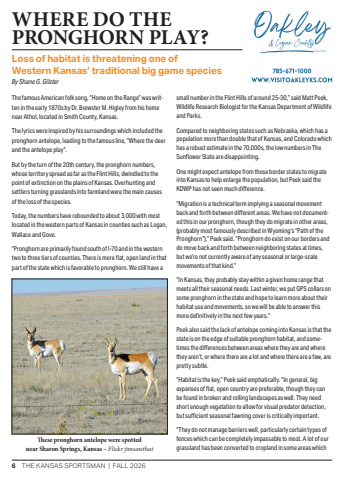
6 THE KANSAS SPORTSMAN | FALL 2026WHERE DO THE PRONGHORN PLAY?Loss of habitat is threatening one of Western Kansas%u2019 traditional big game speciesBy Shane G. GilsterThe famous American folk song, %u201cHome on the Range%u201d was written in the early 1870s by Dr. Brewster M. Higley from his home near Athol, located in Smith County, Kansas.The lyrics were inspired by his surroundings which included the pronghorn antelope, leading to the famous line, %u201cWhere the deer and the antelope play%u201d.But by the turn of the 20th century, the pronghorn numbers, whose territory spread as far as the Flint Hills, dwindled to the point of extinction on the plains of Kansas. Overhunting and settlers turning grasslands into farmland were the main causes of the loss of the species. Today, the numbers have rebounded to about 3,000 with most located in the western parts of Kansas in counties such as Logan, Wallace and Gove.%u201cPronghorn are primarily found south of I-70 and in the western two to three tiers of counties. There is more flat, open land in that part of the state which is favorable to pronghorn. We still have a small number in the Flint Hills of around 25-30,%u201d said Matt Peek, Wildlife Research Biologist for the Kansas Department of Wildlife and Parks. Compared to neighboring states such as Nebraska, which has a population more than double that of Kansas, and Colorado which has a robust estimate in the 70,000s, the low numbers in The Sunflower State are disappointing. One might expect antelope from those border states to migrate into Kansas to help enlarge the population, but Peek said the KDWP has not seen much difference. %u201cMigration is a technical term implying a seasonal movement back and forth between different areas. We have not documented this in our pronghorn, though they do migrate in other areas, (probably most famously described in Wyoming%u2019s %u201cPath of the Pronghorn%u201d),%u201d Peek said. %u201cPronghorn do exist on our borders and do move back and forth between neighboring states at times, but we%u2019re not currently aware of any seasonal or large-scale movements of that kind.%u201d%u201cIn Kansas, they probably stay within a given home range that meets all their seasonal needs. Last winter, we put GPS collars on some pronghorn in the state and hope to learn more about their habitat use and movements, so we will be able to answer this more definitively in the next few years.%u201dPeek also said the lack of antelope coming into Kansas is that the state is on the edge of suitable pronghorn habitat, and sometimes the differences between areas where they are and where they aren%u2019t, or where there are a lot and where there are a few, are pretty subtle.%u201cHabitat is the key,%u201d Peek said emphatically. %u201cIn general, big expanses of flat, open country are preferable, though they can be found in broken and rolling landscapes as well. They need short enough vegetation to allow for visual predator detection, but sufficient seasonal fawning cover is critically important. %u201cThey do not manage barriers well, particularly certain types of fences which can be completely impassable to most. A lot of our grassland has been converted to cropland in some areas which These pronghorn antelope were spottednear Sharon Springs, Kansas %u2013 Flickr jimsawthat


