


Page 50 - Demo
P. 50
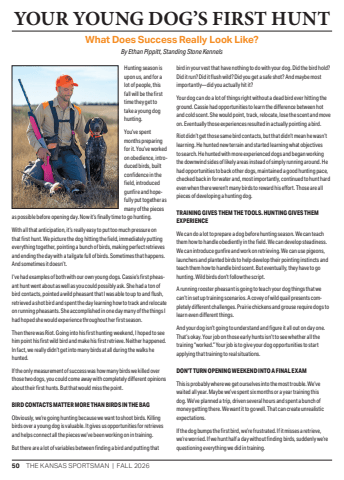
50 THE KANSAS SPORTSMAN | FALL 2026YOUR YOUNG DOG%u2019S FIRST HUNTWhat Does Success Really Look Like?By Ethan Pippitt, Standing Stone KennelsHunting season is upon us, and for a lot of people, this fall will be the first time they get to take a young dog hunting.You%u2019ve spent months preparing for it. You%u2019ve worked on obedience, introduced birds, built confidence in the field, introduced gunfire and hopefully put together as many of the pieces as possible before opening day. Now it%u2019s finally time to go hunting.With all that anticipation, it%u2019s really easy to put too much pressure on that first hunt. We picture the dog hitting the field, immediately putting everything together, pointing a bunch of birds, making perfect retrieves and ending the day with a tailgate full of birds. Sometimes that happens. And sometimes it doesn%u2019t.I%u2019ve had examples of both with our own young dogs. Cassie%u2019s first pheasant hunt went about as well as you could possibly ask. She had a ton of bird contacts, pointed a wild pheasant that I was able to up to and flush, retrieved a shot bird and spent the day learning how to track and relocate on running pheasants. She accomplished in one day many of the things I had hoped she would experience throughout her first season.Then there was Riot. Going into his first hunting weekend, I hoped to see him point his first wild bird and make his first retrieve. Neither happened. In fact, we really didn%u2019t get into many birds at all during the walks he hunted.If the only measurement of success was how many birds we killed over those two dogs, you could come away with completely different opinions about their first hunts. But that would miss the point.BIRD CONTACTS MATTER MORE THAN BIRDS IN THE BAGObviously, we%u2019re going hunting because we want to shoot birds. Killing birds over a young dog is valuable. It gives us opportunities for retrieves and helps connect all the pieces we%u2019ve been working on in training.But there are a lot of variables between finding a bird and putting that bird in your vest that have nothing to do with your dog. Did the bird hold? Did it run? Did it flush wild? Did you get a safe shot? And maybe most importantly%u2014did you actually hit it?Your dog can do a lot of things right without a dead bird ever hitting the ground. Cassie had opportunities to learn the difference between hot and cold scent. She would point, track, relocate, lose the scent and move on. Eventually those experiences resulted in actually pointing a bird.Riot didn%u2019t get those same bird contacts, but that didn%u2019t mean he wasn%u2019t learning. He hunted new terrain and started learning what objectives to search. He hunted with more experienced dogs and began working the downwind sides of likely areas instead of simply running around. He had opportunities to back other dogs, maintained a good hunting pace, checked back in for water and, most importantly, continued to hunt hard even when there weren%u2019t many birds to reward his effort. Those are all pieces of developing a hunting dog.TRAINING GIVES THEM THE TOOLS. HUNTING GIVES THEM EXPERIENCEWe can do a lot to prepare a dog before hunting season. We can teach them how to handle obediently in the field. We can develop steadiness. We can introduce gunfire and work on retrieving. We can use pigeons, launchers and planted birds to help develop their pointing instincts and teach them how to handle bird scent. But eventually, they have to go hunting. Wild birds don%u2019t follow the script.A running rooster pheasant is going to teach your dog things that we can%u2019t in set up training scenarios. A covey of wild quail presents completely different challenges. Prairie chickens and grouse require dogs to learn even different things.And your dog isn%u2019t going to understand and figure it all out on day one. That%u2019s okay. Your job on those early hunts isn%u2019t to see whether all the training %u201cworked.%u201d Your job is to give your dog opportunities to start applying that training to real situations.DON%u2019T TURN OPENING WEEKEND INTO A FINAL EXAMThis is probably where we get ourselves into the most trouble. We%u2019ve waited all year. Maybe we%u2019ve spent six months or a year training this dog. We%u2019ve planned a trip, driven several hours and spent a bunch of money getting there. We want it to go well. That can create unrealistic expectations.If the dog bumps the first bird, we%u2019re frustrated. If it misses a retrieve, we%u2019re worried. If we hunt half a day without finding birds, suddenly we%u2019re questioning everything we did in training.


