


Page 30 - Demo
P. 30
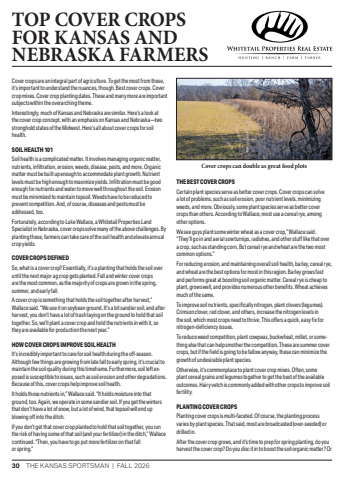
30 THE KANSAS SPORTSMAN | FALL 2026Cover crops are an integral part of agriculture. To get the most from these, it%u2019s important to understand the nuances, though. Best cover crops. Cover crop mixes. Cover crop planting dates. These and many more are important subjects within the overarching theme.Interestingly, much of Kansas and Nebraska are similar. Here%u2019s a look at the cover crop concept, with an emphasis on Kansas and Nebraska%u2014two stronghold states of the Midwest. Here%u2019s all about cover crops for soil health.SOIL HEALTH 101Soil health is a complicated matter. It involves managing organic matter, nutrients, infiltration, erosion, weeds, disease, pests, and more. Organic matter must be built up enough to accommodate plant growth. Nutrient levels must be high enough to maximize yields. Infiltration must be good enough for nutrients and water to move well throughout the soil. Erosion must be minimized to maintain topsoil. Weeds have to be reduced to prevent competition. And, of course, diseases and pests must be addressed, too.Fortunately, according to Luke Wallace, a Whitetail Properties Land Specialist in Nebraska, cover crops solve many of the above challenges. By planting these, farmers can take care of the soil health and elevate annual crop yields.COVER CROPS DEFINEDSo, what is a cover crop? Essentially, it%u2019s a planting that holds the soil over until the next major ag crop gets planted. Fall and winter cover crops are the most common, as the majority of crops are grown in the spring, summer, and early fall.A cover crop is something that holds the soil together after harvest,%u201d Wallace said. %u201cWe use it on soybean ground. It%u2019s a bit sandier soil, and after harvest, you don%u2019t have a lot of trash laying on the ground to hold that soil together. So, we%u2019ll plant a cover crop and hold the nutrients in with it, so they are available for production the next year.%u201dHOW COVER CROPS IMPROVE SOIL HEALTHIt%u2019s incredibly important to care for soil health during the off-season. Although few things are growing from late fall to early spring, it%u2019s crucial to maintain the soil quality during this timeframe. Furthermore, soil left exposed is susceptible to issues, such as soil erosion and other degradations. Because of this, cover crops help improve soil health.It holds those nutrients in,%u201d Wallace said. %u201cIt holds moisture into that ground, too. Again, we operate in some sandier soil. If you get the winters that don%u2019t have a lot of snow, but a lot of wind, that topsoil will end up blowing off into the ditch.If you don%u2019t get that cover crop planted to hold that soil together, you run the risk of having some of that soil (and your fertilizer) in the ditch,%u201d Wallace continued. %u201cThen, you have to go put more fertilizer on that fall or spring.%u201dTHE BEST COVER CROPSCertain plant species serve as better cover crops. Cover crops can solve a lot of problems, such as soil erosion, poor nutrient levels, minimizing weeds, and more. Obviously, some plant species serve as better cover crops than others. According to Wallace, most use a cereal rye, among other options.We see guys plant some winter wheat as a cover crop,%u201d Wallace said. %u201cThey%u2019ll go in and aerial sow turnips, radishes, and other stuff like that over a crop, such as standing corn. But cereal rye and wheat are the two most common options.%u201dFor reducing erosion, and maintaining overall soil health, barley, cereal rye, and wheat are the best options for most in this region. Barley grows fast and performs great at boosting soil organic matter. Cereal rye is cheap to plant, grows well, and provides numerous other benefits. Wheat achieves much of the same.To improve soil nutrients, specifically nitrogen, plant clovers (legumes). Crimson clover, red clover, and others, increase the nitrogen levels in the soil, which most crops need to thrive. This offers a quick, easy fix for nitrogen-deficiency issues.To reduce weed competition, plant cowpeas, buckwheat, millet, or something else that can help smother the competition. These are summer cover crops, but if the field is going to be fallow anyway, these can minimize the growth of undesirable plant species.Otherwise, it%u2019s commonplace to plant cover crop mixes. Often, some plant cereal grains and legumes together to get the best of the available outcomes. Hairy vetch is commonly added with other crops to improve soil fertility.PLANTING COVER CROPSPlanting cover crops is multi-faceted. Of course, the planting process varies by plant species. That said, most are broadcasted (over-seeded) or drilled in.After the cover crop grows, and it%u2019s time to prep for spring planting, do you harvest the cover crop? Do you disc it in to boost the soil organic matter? Or Cover crops can double as great food plotsTOP COVER CROPS FOR KANSAS ANDNEBRASKA FARMERS


